Generate Smart Summary
As businesses and consumers become increasingly aware of their environmental footprint, the popularity of strategies, such as IT lifecycle extensions, is growing. But what is your carbon footprint, and how do your hardware choices affect it?
In this guide, we will explore the environmental impacts of lifecycle extension vs. buying brand-new hardware. Discover how rethinking your business’s hardware refresh strategy could help you save costs and reduce your impact on the planet.
What is the carbon footprint of IT hardware?
The CO2 footprint of IT equipment refers to the total amount of greenhouse gas emissions an asset causes throughout its entire lifecycle.
We generally divide a device’s carbon footprint into two types:
- Embodied Carbon: The gases produced during the manufacturing, transport and disposal of an asset.
- Operational Carbon: The carbon dioxide and other GHG emissions produced by the asset while it is in use.
In this guide, we focus on the embodied carbon produced by new hardware assets vs IT lifecycle extension strategies.
As the depletion of natural resources is a significant environmental consequence of the IT industry, we also consider the amount of ore extracted from the earth in each process.
Key metric: We primarily measure an asset’s carbon footprint in kilograms of carbon dioxide equivalent (kgCO2e) per device.
What is the environmental impact of manufacturing new hardware?
The manufacturing stage is the largest contributor to IT equipment’s carbon footprint.
Key fact: IT hardware manufacturing is responsible for up to 80% of an IT device’s total carbon emissions throughout its entire life.
This impact comes from several stages of the production process, including::
- Extraction of raw materials, such as rare earth elements and metals
- Construction and assembly of parts
- Transport and distribution of materials, parts and completed devices
The exact quantity of greenhouse gases emitted throughout these processes will vary depending on factors such as device type and manufacturing practices. However, the average production process of a new tower server can generate up to 1200 kgCO2e.
Beyond emissions, manufacturing also places considerable strain on natural resources. Mining activities required for raw material extraction contribute to resource depletion, high water consumption, and environmental pollution. In many cases, only a small portion of extracted material is ultimately used. For instance, obtaining just 1.5 kg of rare earth elements—critical for components like hard drives and circuit boards—can require processing large volumes of ore, resulting in substantial waste and ecosystem disruption.
Why do businesses choose new hardware?
Businesses may choose to replace or expand their IT infrastructure for several reasons. These can include:
- Scaling up to accommodate increased business operations
- Failure or degrading performance of previous hardware
- Data center migrations posing an opportunity to refresh
- AI adoption
They might choose brand-new assets over IT lifecycle extension because they require a certain level of performance, security or specific characteristics that only a new model can offer them. However, it is vital to be aware of the environmental impact of these choices.
What sustainable IT solutions can you implement to reduce your carbon footprint?
Businesses have a widening range of options to control and minimize their IT’s carbon footprint. These range from virtualization and switching to renewable energy, to building data centers with sustainable materials and implementing liquid cooling techniques.
However, one of the simplest, most affordable and immediately actionable strategies to improve any IT infrastructure’s sustainability rating is to extend the lifecycle of the equipment they already own.
What does it mean to extend the lifecycle of IT equipment?
IT lifecycle extension maximizes the timespan in which a device is usable and active.
Traditionally, manufacturers and businesses tend to follow a linear model when it comes to IT equipment lifecycle: extraction of resources, manufacturing, sale, use and disposal.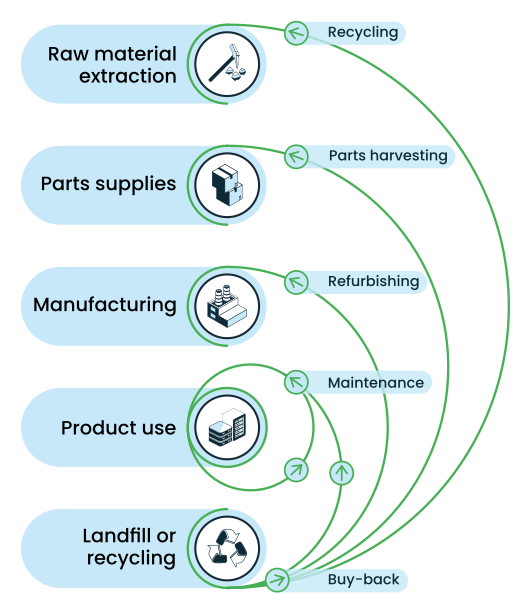
However, when IT assets reach their End-of-Life, or even their End-of-Support dates, that doesn’t mean they cease to function or be of value to businesses. With correct management, they can continue to perform well for years after the OEM recommends replacement. This is where IT lifecycle extension comes in.
Lifecycle extension breaks away from the linear model and keeps IT assets in service for longer, whether this is through maintenance or by recycling materials and components for reuse or resale. This approach of keeping equipment in use and in the market is known as the circular economy.
How can businesses contribute to the circular IT market?
There are several circular solutions businesses can leverage to reduce the environmental impact of their infrastructure, as well as reduce IT costs.
| Solution | What does it do? | How does it support sustainability efforts? |
|---|---|---|
| Buy-back | Businesses can sell their unwanted hardware to vendors and recuperate part of their investment. | Buy-back schemes prevent unused hardware from going to landfill or staying idle in data centers. They also allow other companies to purchase these assets on the secondary market instead of buying new. |
| Maintenance | Keeps existing hardware performative, secure and resilient past its EOL and EOSL dates. | Maintaining hardware in good working condition means businesses can continue to use them for longer. This delays new purchases and avoids unnecessary disposal. |
| Refurbishment | Returns pre-owned hardware to a like-new state before resale. This can add 3-5 years onto the lifecycle of an existing device. | Refurbishment gives components a second life, while extending the lifecycle of the asset receiving the spare part. This saves both the component and the asset from disposal, while avoiding the resource extraction, construction and assembly of new devices. |
| IT recycling | Processes materials such as rare earth metals, glass and plastic for recycling and reintroduction into the economy. | This limits the exhaustion of finite resources and reduces the demand for damaging extraction practices. This in turn avoids the generation of CO2 and land damage through mining. |
Find out why businesses are breaking the server refresh cycle.
Read our expert Q&A to learn why SMBs are replacing traditional OEM support and refresh cycles with strategic IT lifecycle extension.
What is driving the shift toward IT lifecycle extension?
While investing in brand new assets can sometimes be inevitable, businesses are increasingly breaking away from traditional hardware replacement cycles and moving towards IT lifecycle extension strategies. Let’s dive into some of the top reasons why:
Sustainability goals
In 2025, global carbon emissions from fossil fuels hit a record high. As the effects of climate change are already being felt, consumers and businesses are shifting towards purchases and strategies that leave a minimal environmental impact, both in the short and long term.
This is where IT lifecycle extension takes on a key role. The Technology Carbon Standard confirms that amortizing a server’s embodied carbon emissions can significantly reduce the device’s environmental footprint, lowering its annualized carbon production.
Amortizing embodied carbon emissions means spreading the quantity of carbon produced during manufacturing, transport and disposal over more years.
Economic drivers
Supply chain disruptions, resource shortages and geo-political tensions are all key factors pushing up the prices of IT hardware. The costs of new enterprise servers have been surging since mid-2025 and are showing little sign of slowing down. HPE even announced in 2026 that costs may change between quotation and shipment, leaving IT teams unable to plan budgets with security.
As costs, wait times and general uncertainty rise, businesses are delaying replacements and focusing on maximizing the ROI of the equipment they already use.
Compliance requirements
Governments across the world are introducing strict legislation that mandates the responsible management and disposal of IT hardware. For example, the EU’s WEEE Directive prioritizes waste prevention, reuse, and recovery of materials, requiring enterprises and producers to manage EOL equipment responsibly.
Hardware disposal can therefore create both economic and administrative pressures, as well as non-compliance risks if managed poorly.
The combination of regulations and incentives, such as those offered by the Circular Economy Action Plan, encourages businesses to extend the lifecycle of their IT infrastructure rather than pursue standard replacement cycles.
Calculating your infrastructure’s CO2 footprint
Being able to measure the impact of your IT hardware decisions can help businesses make more informed choices.
With Evernex’s carbon footprint calculator tool, you can find out how much CO2e your business could save through IT lifecycle extension in real time.
All you have to do is enter the number of servers, storage devices or networking assets in question, and by how many years you are considering extending their lifespan. Evernex does the math for you with unbiased & backed results.
New hardware vs. IT lifecycle extension: The key takeaways
Investing in brand new hardware and disposing of older assets both have considerable environmental and economic impacts. These are:
- Heightened embodied greenhouse gas emissions during resource extraction, manufacturing, transport and disposition.
- Consumption of limited natural resources.
- E-waste generation, which fills landfills and pollutes the surrounding earth.
In contrast, lifecycle extension, whether it be through refurbishment or maintenance, drastically decreases businesses’ overall carbon footprint. This is because:
- Lifecycle extension cuts annualized carbon emissions (spreading embodied emissions over more years).
- Keeping resources within the circular market minimizes the need to extract more materials.
- Limiting the frequency of device disposal helps prevent the generation of electronic waste.
Rethink your hardware refresh strategy to improve your carbon footprint and save your business money!